
9 Mining Archaeology at Bastenberg
Traces on the mountain
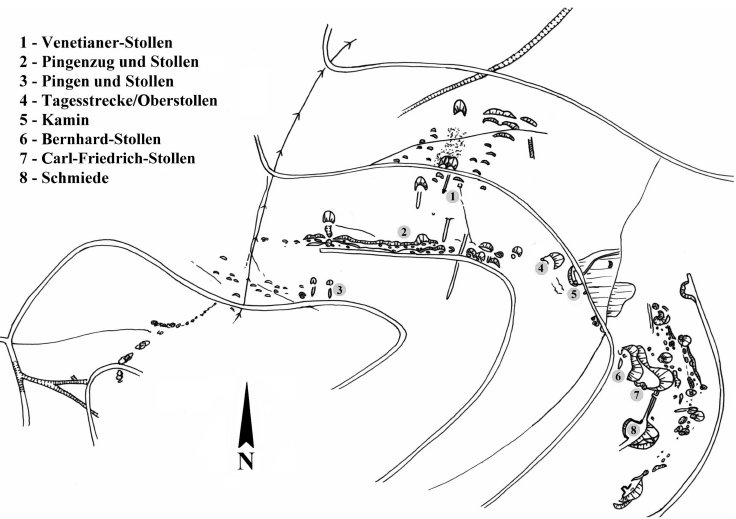
Archaeological research into medieval lead, silver and copper ore mining in the Bastenberg near Bestwig-Ramsbeck dates back to the first half of the 20th century. In 1936, Heinrich Quiring published a description of the so-called Venetian gallery and dated it, according to the state of knowledge at the time, to the Bronze Age (in Central Europe from about 2200 to 800 BC). In the 1970s, the tunnel was surveyed by the German Mining Museum in Bochum. Castings of the gallery were made at various points. In 1999, systematic archaeological prospection and documentation began above ground, followed by a survey of the adit and the associated excavation areas.
On the surface, the course of the Bastenberggang is traced by a series of fractured shafts (pits). These, together with the Upper Adit and the Venetian Adit, are probably the oldest montane archaeological features on the Bastenberg. The name „Venetian gallery“ already appears on mine plans from the end of the 18th century. This led to it being associated with the legendary Venetians. However, the name is more likely to express that the gallery was considered very old, but that no one was able to determine exactly when it had been created.
During an archaeological prospection, pottery shards, slag and a quarter of a cast lead cake were recovered from a dump below the Venetian gallery. The pottery dates to the 11th – 13th centuries, i.e. before the first written mention of mining. The majority of the pottery finds can be assigned to the 12th and 13th centuries.
A narrowly defined area on the slag heap, characterised by a concentrated occurrence of slag and charcoal, can be assumed to be a blacksmith’s site. Based on a pottery find, it can be dated to the 12th – 13th century. Radiocarbon dating points to the 11th – 12th centuries.
In the Middle Ages, mining at Ramsbeck initially took place in parts of the ore vein near the surface. As mining progressed into the depths, galleries were built for extraction and drainage from the slope. It is still unclear how deep the medieval mining reached. From the early modern period onwards, mining presumably shifted further towards the Valmetal, as the higher-lying deposits of lead, silver and copper ores had been exploited. According to the overall findings, the Venetian gallery was already of little importance for mining operations at this time. In the 19th century, the upper parts of the deposit were mined for zinc blende. In the process, medieval workings were cut and cleared as necessary.
Martin Strassburger M.A.
Fig.: Sketch map of the mining archaeological features in the vicinity of the Venetian gallery.
A project in cooperation with the LWL-Archäologie Westfalen.