
30 Willibaldstollen III
In earlier times, the Willibaldstollen III (mouth 469.70 m above sea level) was the main haulage route for the entire ore extraction of the Dörnberg and Aurora mines, which were connected by a continuous tunnel. The Aurora shaft was used to transport most of the worthless „mountains“ (dead rock) produced in the mine to the dump in order to relieve the main extraction.
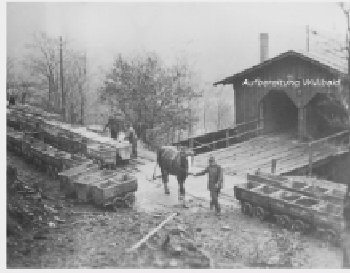
Initially, ponies were used for haulage, later more powerful horses that could move three times the amount of ore. For this purpose, lighter mobile lorries with a capacity of 600 kg were put into operation. From 1933 diesel locomotives, and from 1950 battery locomotives, took over transport to the processing plant. The curvatures of the ore galleries had to be straightened for the longer trains with the larger wagons. On the resulting steeply sloping routes, the locomotives sometimes needed more braking power than tractive power. Roadway haulage in Adit III was discontinued in 1962. A new underground double-drum winding machine at the level of the Eickhoff adit – designed for a final depth of 550 m – made it possible to connect deeper levels to the winding system through the blind shaft.
From now on, the entire ore production – now only from the deep mining levels – was extracted via the blind shaft 1 and the Margareten shaft to the Eickhoffstollen level. From a small reloading bunker, the ore then travelled along an inclined conveyor (conveyor length 628 m) to the primary crusher at the mouth of adit III. After the mine was closed down in 1974, the adit is still used for ventilation and, if necessary, as access for the rescue service to the visitor mine.