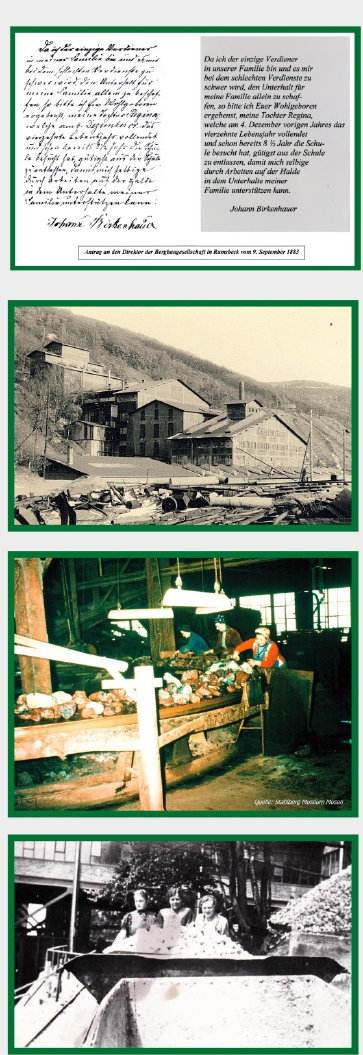

29 „Erzengel“ on the Production Line –Women’s Work in Mining
When it comes to working in the mine, the miner naturally plays the leading role. But in earlier times, boys, girls and women also worked in the mines above ground in our homeland: Poch boys crushed the ores with a hammer, girls from the age of 14 and women sorted the metal-rich rock from the numb (metal-poor) rock by hand. „Archangels“ they were often mocked despite their hard work.
The word ‚Erzengel‘ is a pun derived from the German word ‘ore’ also meaning ‘Erz’ and alluding to the biblical term ‘archangel’ describing the women at work at the plant.
After being transported from the mine to the processing buildings on the slope of the Dörnberg, the ores were first crushed by a crusher and then washed with a lot of water in a rotating, huge drum. From the drum they then went to a conveyor belt. The metal-rich pieces of ore were picked out by girls and women and collected in containers, under which the conveyor belt ran; the numb rock continued to run until it reached the tailings pile.
The girls (14 years and older) and young women came mainly from Ramsbeck, Andreasberg and Heringhausen. The girls and women from Andreasberg usually used the footpath „übern Kopp“ (note: Pult 34 is on this path!). In the winter, they got – without official permission – through the Carl Haber adit and adit III to the processing plant. Their colleagues from Heringhausen came by bicycle in all weathers.
An eyewitness remembers the 1930s: „The big drum poured the rock with a roar and a great gush of water – in winter there were sometimes lumps of ice – onto a still very primitive conveyor belt. The girls stood here on both sides, at specially marked points. We wore aprons and were given gloves. At first, I eagerly ran along behind the belt. Then our supervisor told me to stay firmly in my designated place. Further down, the girls still had enough to pick.
After only two days, you had torn, aching hands because the stones were so sharp-edged. The gloves only lasted 2-3 days. It was bad in winter; we crept home completely frozen. Working hours lasted from 6 a.m. to 4 p.m. every working day. We were paid 3.50 marks and had health insurance. The wages were dutifully given to my mother, who only gave me a few pennies on special occasions.“
Another contemporary witness recounts: „From 1942 to 1945, I read ores on one of the three large conveyor belts. Two belts were in constant use. On either side of one belt – we also said ‚reading beams‘ – stood six to seven women. I was 17 years old when I started working there. The supervising steward threw small stones from above when we talked or sang at work. Gripping the wet ore stones made our fingers sore. We didn’t get gloves; they wouldn’t have done any good either. We cut pieces of hose to fit and pulled them over our fingers. To make it easier for us to reach the reading tape, we stood on heating pipes.
We had to start at six in the morning. At three in the afternoon the shift was over. At half past nine we had a breakfast break, at half past one a lunch break. High up in the building was a recreation room. I think we earned two marks an hour. That wasn’t much. When it was payday, you had to see if there was anything in the pay packet at all.“
The work of the „ore angels“ on the reading belt in the Ramsbeck processing plant probably ended around 1950, when a floating and sinking plant with a 50 tonne per hour throughput was built as the first plant in German ore mining that could separate a large part of the mountains from the raw ore.