
28 Ore Processing Plant ‚Willibald‘
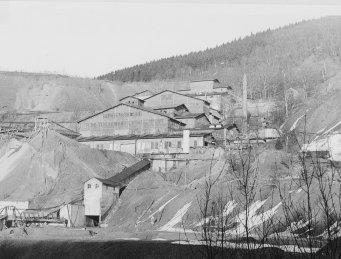
Here – on the south-western slope of the Dörnberg – stood the „Willibald“ ore processing plant. Construction of the huge plant, built in terraces on the mountainside, began in 1889/90 under the then mine director Carl Haber. In the years that followed, it was expanded and enlarged according to the state of the art.
In order to smelt the ore mined in the Ramsbeck mine, which had a metal content of about 1.7% lead and 4.8% zinc, it first had to be prepared for smelting in this plant. With the help of physical and chemical processes, about 93% of the lead and 97% of the zinc in the raw ore were transformed into smeltable end products. At times, up to 90 workers and 10 supervisors were employed in the processing plant.
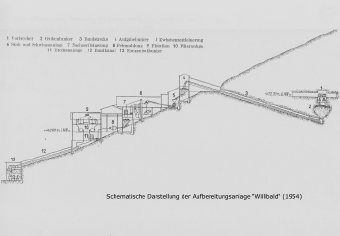
The operational sequence can be followed in simplified form in the schematic diagram on the right.
- the raw material was crushed underground in gallery III (main haulage road) until 1962, and then in a primary crusher at the blind shaft (Eickhoff gallery) to less than 80 mm.
- The crushed material fell into a pit bunker (capacity 1,000 tonnes).
- from the mine bunker, the ore was transported to the processing plant on a belt conveyor with a gradient of approx. 15% above ground.
- after continuous registration, the raw ore quantity was fed to the feed hopper.
- On this level was the pre-classification and intermediate crushing. There the ore wasthe ore to a grain size of less than 40 mm.
- in the subsequent sinking and floating facilities, the ore was brought to the different densities of ore-bearing and dead (hardly ore-bearing) rock.up to 60% of the raw ore was separated as waste rock. The resulting coarse „floating mountains“ of waste rock were dumped in a heap and then used mainly for road construction.
- the ore product (tailings), enriched to about 4% lead and about 10% zinc, was then crushed to less than 10 mm in a crusher, and
- ground even finer to a grain size of less than 0.3 mm by four mills filled with steel balls with the addition of water.
- by adding special chemicals, the so-called flotation was used to separate galena and zinc blende one after the other from the solid/water mixture (called turbidity) obtained in the fine grinding. The result was concentrates with a content of about 65% lead and 50-55% zinc. – The virtually metal-free „mountains“ (sludges) produced during flotation were initially pumped from the processing plant through pipelines to treatment ponds on the slopes of the Dörnberg, and later into the Bilmecke valley (below Andreasberg). Here alone, about 2 million cubic metres of „mountains“ are said to lie as sand.
- the next step was to dewater the ore concentrates on vacuum drum filters,
- afterwards they were thermally dried.
- via a channel with a conveyor belt, they finally arrived at the
- concentrate bunker, which could accommodate about two days‘ production.
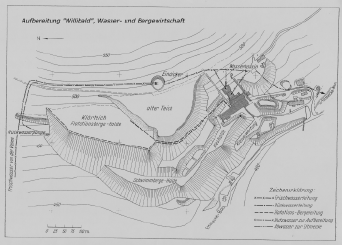
The ore concentrates were transported to the so-called Bremsberg (loading station) on the slope of the Scheidt Hill by a trolley railway (see Bremsberg station!). They were then transported to Bestwig station by mine train (called a „little train“). From 1952 onwards, special Buessing trucks took over the entire transport. Finally, the lead and zinc concentrates were transported from Bestwig to the works‘ own smelters in Nievenheim on the Rhine and in Stolberg near Aachen.
After the closure of the Ramsbeck mining operation in 1974, the entire „Willibald“ ore processing plant was dismantled and the site subsequently recultivated.