
27 Saint Barbara – Patron Saint of Miners
The life and person of St Barbara herself lie in the darkness of history: What is known about Barbara is told to us by many legends with a kernel of „truth“. On depictions of the saint one often also sees a tower, a chalice, a palm branch, a sword or a crown. The commemoration day of St. Barbara is celebrated on 4 December.
According to legend, she lived and died as a martyr in the late/early 3rd and 4th centuries northeast of Istanbul in what is now Turkey. Her father was a pagan merchant and loved his daughter more than anything. But because he was very jealous and suspicious, he always locked her up in the tower of his house when he was travelling. When Barbara learned about Christianity from one of her teachers, she was baptised in her father’s absence and had a third window added to the tower as a reminder of the Trinity.
Barbara’s father was horrified and tried everything to dissuade her from Christianity. When Barbara steadfastly resisted his wishes, she finally had to flee in fear of her life from the relentless wrath of her father, who persecuted her and searched everywhere for her. She was able to hide for a short time, but was betrayed by a shepherd. The father brought the defenceless daughter back home, abused her cruelly and, after sentencing her to death, finally beheaded her himself with his sword. For this he was struck dead by lightning on his way home. All this is said to have happened on a 4th of December.
But why do the miners venerate St. Barbara, one of the 14 emergency helpers, as their patron saint? Legend has it that Barbara was at the end of her tether when she fled down a steep mountainside. In her fear of her father, she prayed to God: „Help me! Show me an opening in the rocks where I can hide!“ Sure enough, the girl found a deep crevice in the rock that gave her shelter until she was betrayed by a shepherd.
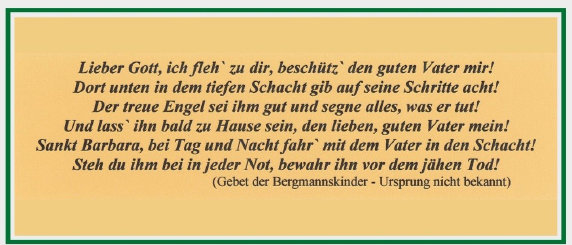
The miner, too, always wanted the mountain to open up and show the way to the valuable ore. It is easy to explain why he chose St. Barbara in particular as his helpmate. In ancient times, the miner began his hard and perilous work with the wish „Glück zu!“ He wanted to express with this: If I pray to St. Barbara for help and am lucky like her, she will lead me to rich mineral resources and let me return to daylight in good health. Later, when the shafts reached ever greater depths, „Glück zu“ (good luck) became „Glück auf!“ (meaning: ‘Have a safe journey up to the surface again’). That is why St. Barbara has remained the patron saint of miners, among others, to this day. St. Barbara also has a high status in our former mining community: the Catholic church in Andreasberg is dedicated to her. In front of the church in Ramsbeck she is carved in stone with a tower, and the miners donated a Barbara window for each of the two places of worship.
There have always been many customs surrounding the martyr’s day of remembrance on 4 December: everyone is familiar with the „Barbara branches“ that are cut from cherry trees and placed in water on this day. They are supposed to blossom in the heated room at Christmas. For the miners, 4 December was already a holiday in olden times, with a church service followed by a feast at which a miners‘ band in miners‘ uniforms played. Since 1979, former miners have met in Andreasberg on Barbara Day and shared memories. In addition, blessed Barbara branches have been brought in procession from the Carl Haber gallery to the church there for some time. Every year since 1995, numerous guests have taken the mine train into the visitor mine on 4 December to celebrate a service in memory of St Barbara underground at the former tipping