
26 Willibaldstollen IV
As early as 1668, an exploration report in Ramsbeck mentions the „Dörnberg“ mine, among others, „… allda ist Sylber, Bley und Kupfer in eingesprengter Blende worden …“. Since then, numerous galleries have been excavated in the Dörnberg – as in the Bastenberg – to reach the ore veins: On the west side, these include the Willibaldstollen I, II, III and IV at a height of 523 m to 423 m above sea level.
Ore mining in the Dörnberg or Stüppel was carried out in two extensive mine fields, the „East Field“ (near the Aurora and Margarethen Shafts) and the „West Field“ (aligned with Blind Shaft 1). The miners working in the east field entered the mine by rope via the Aurora shaft.
All the miners employed in the Westfeld reached the workings below the Eickhoff gallery through the Willibald gallery IV, in the immediate vicinity of which was the wash-house.
In 1954, a total of 611 people were employed in the Ramsbeck district; 285 came from Ramsbeck, 164 from Andreasberg, 46 from Elpe or Heinrichsdorf, 15 from Heringhausen and 101 from the surrounding area.
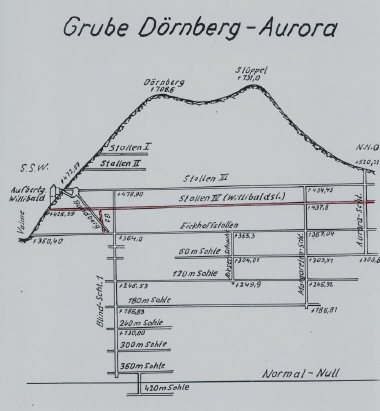
After the inauguration of the new operating facility in front of the Eickhoff gallery – today’s mining museum – in November 1955, this was the only entry and exit point for all miners until its closure in 1974.
The Aurora shaft was shut down and the Willibaldstollen IV was closed. From 1840 to 1974, thousands of miners extracted 16.7 million tonnes of raw ore with an average metal content of 4.8 % zinc, 1.7 % lead and 17 grammes of silver per tonne from the mines in the Ramsbeck district.