
23 Former settlement of the smelters
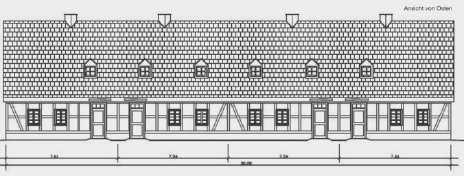
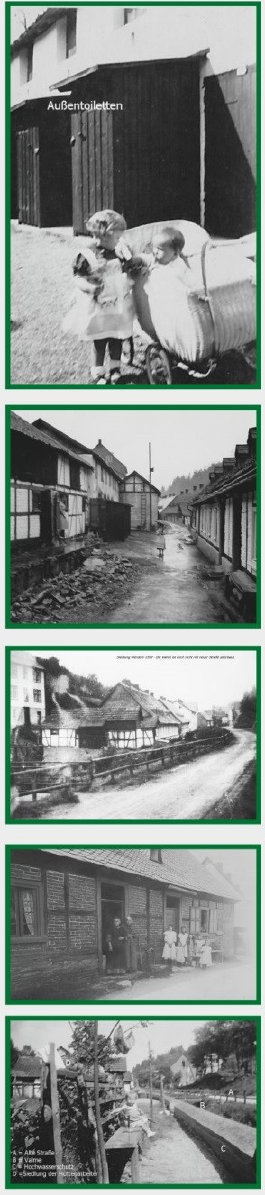
The single-storey houses to the left of the Valme, all of which have been privatised, still show a uniform basic form today, despite all the changes. Built in 1854, they served as housing mainly for the smelter workers. The houses are among the earliest workers‘ settlements in Germany.
Four families lived in each house. On the ground floor, there were utility and living rooms: Laundry and cattle kitchen, kitchen, dining room and parlour. The bedrooms for parents and children were on the upper floor and in the attic. Small windows and relatively cramped rooms still give an impression of the limited living conditions.
The construction method is also uniform: half-timbering set on greywacke, which forms the foundation. The half-timbered fields were usually filled with brick masonry, which was then given a coat of white lime paint. The roofs were covered with felt or slate tiles. There were no cellars. The houses of the former miners‘ settlements in Andreasberg and Heinrichsdorf were built in the same way.
Each dwelling had a stable for the goats, pigs and chickens and for storing fodder supplies, as well as a shed for garden tools and fuel. Drinking water was drawn from a well outside the house. The toilets were also outside. The right to live in these houses was usually dependent on the men’s affiliation to the mining companies.
The entire housing complex gives us information about the living conditions of the workers in the 19th and 20th centuries. Keeping livestock and cultivating kitchen gardens were an indispensable supplement to the wages earned. The supply of food had to be provided mainly by the workers themselves, especially as most of the families had many children. A wall protected the dwellings from floods. The Valme could be reached through openings in the wall via a staircase. The inhabitants usually washed their laundry in the clear water of the stream. During floods, the entrances could be closed.
The entire settlement stood out clearly from the farms in the centre of the village and the modest, yet more individualised private houses, if only because of the way it was built. The uniformity of the settlement points to the fact that all residents were equally employed as workers in the mining companies. The proximity of the dwellings to the industrial plants on the Werdern also shows the residents‘ affiliation to this modern working world.
Over time, a separate residential milieu or socialisation formed here with shops, pubs and even its own groups and clubs.