

22 The industrial facilities „Auf dem Werdern“
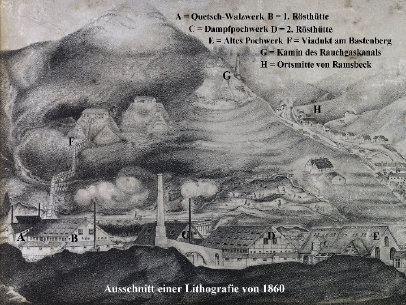
A = squeezing rolling mill
B = 1st roasting mill
C = Steam poaching plant
D = 2nd roasting hut
E = Old stamping mill
F = Bastenberg viaduct
G = Chimney of the flue gas duct
H = Ramsbeck town centre
Until the beginning of the 20th century, the raw ore in Ramsbeck was mainly extracted from the tunnels of the Bastenberg. In front of the adit mouths, the miners and poch boys separated the metal-rich ores from the dewy rock, which was piled up on the mountainside, by hand as far as possible. The raw ore itself was transported over a viaduct (see illustration!) down into the valley to the stamping works and roasting huts, where it had to be laboriously processed.
The processing of the raw ore, which was closely intergrown with the surrounding rock, in the Poch washing plant is described in detail at Station 18 of the Mining Trail (model of a ‘Pochwerk’). The ore concentrate extracted in the ‘Pochwerk’ was then heated to about a thousand degrees in the roasting smelters by air supply in preparation for the actual smelting (production of saleable metals) to remove the sulphur bound to the metal. The sulphur was transformed into gaseous sulphur dioxide (SO²), which was discharged through a chimney.
The first documented Poch washing plant in Ramsbeck was commissioned in 1825 on the Valme, directly south of the old lead smelter. Between 1835 and 1840, and from 1853 onwards, further Poch washing plants were built on the right bank of the Brabecke stream „auf dem Werdern“.
As in 1825, the mining authorities, in the interest of the rural population and in response to their protests, had ordered extensive measures to limit the damage, including the construction of dams, sewage sumps and secured dumps.
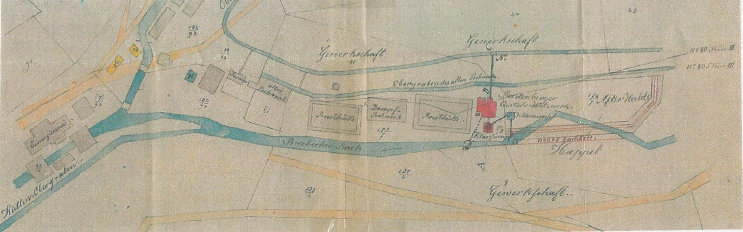
The above-mentioned large coloured site plan from April 1856 was made as an attachment to an application for approval of the „Bastenberger Quetsch-Walzwerk“, which is marked in red. You can also see the location of the planned sewage sumps and the dam on the bank of the Brabecke stream. On the left the „Hütten-Obergraben“ can be seen, which leads to the lead smelter, and right next to it the two originally planned so-called water castles above the Valme (cf. plate 21!). The „Happel“ property belonged to the mill owner Anton Happel, a spokesman against the mining company because of its installations of environmentally damaging Poch washing plants.
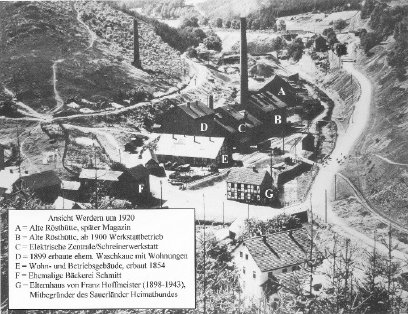
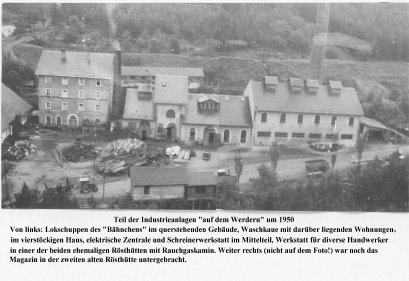
After the construction of the central processing plant „Willibald“ in 1890 and the relocation of mining from the Bastenberg to the Dörnberg, the old facilities „auf dem Werdern“ were no longer necessary. From then on, the Stolberger Zink AG used these mining facilities to set up a construction office, a magazine and workshops for the employed craftsmen such as carpenters, bricklayers, locksmiths, blacksmiths, electricians and painters. Apprentices were also trained in these trades. They usually did not receive an apprenticeship contract, attended the miners‘ vocational school in Ramsbeck and were taken on after three years as company fitters, company electricians …. This training usually guaranteed a long-term commitment of the „trainee“ to the employer. The same training practice applied to the commercial professions. In the mine surveyor’s office, general apprenticeship contracts were concluded from 1954. Here there was also a final apprenticeship examination for mining surveyor at the mining school in Aachen after 3 ½ years. The offices of the commercial employees and the mine surveyor’s office were set up in the administration building.