
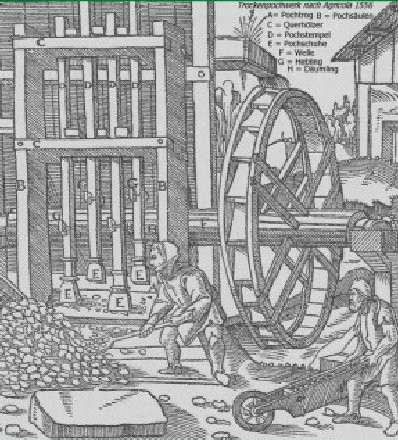
18 Model of a Punching Mill for the Preparation of the Ores
When mining the silver-bearing lead ores of the Bastenberg and Dörnberg mountains, the miners usually separated the mineral-rich ores from the dewy rock in the adit. In addition, the miners were given the task of hammering down the good pieces of ore after they had been mined in front of the gallery mouth. For the mines extracting in Ramsbeck, poke mills were also built near the Valme to further process the mineral-rich, good ore before it could be smelted in the smelter. Such poaching mills had already stood above the grain mill before 1800 and occasionally interfered with mill operations because they also used the water power of the Valme. In 1825, between 1835 and 1840, and from 1853 onwards, the last poaching works were built in the area of the smelter and the moated castle and – like others in the area – remained in operation until 1889/90, before they were replaced by the modern „Willibald“ processing plant on the western slope of the Dörnberg.
Schematic cross-section through a punching machine
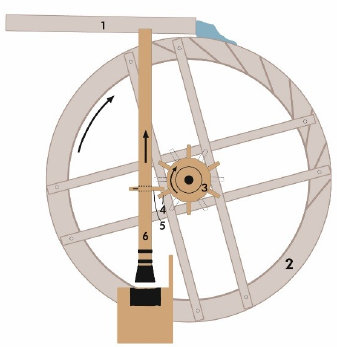
1 channel (water feed)
2 Upper water wheel (water feed from above)
3 horizontally mounted shaft
4 Cam or Thumbelina
5 Lifting
6 Punch
7 Iron punch shoe
8 Poke sole with iron plate
There were dry and also wet poaching mills, which were constructed very similarly. In a dry-poking mill, the water is fed through a channel (1) from above onto the water wheel (2). This drives a horizontally mounted, thick shaft (3). The long, rounded-off cams or thumblings (4) protrude from this shaft at intervals between the rows of punches. When the shaft rotates, the thumblings grip under the lifting rings (5) protruding from the punches. This raises the heavy punches (6) one after the other by about 30 centimetres. The shaft with the thumblings continues to rotate and the thumblings release the lifting pistons again. In quick succession, the thumblings crash down with full force and a deafening noise. With their cast-iron punching shoes (7) at the lower end, they smash the ore thrown onto the iron plate of the punching sole (8).