
15 The Josephus Gallery
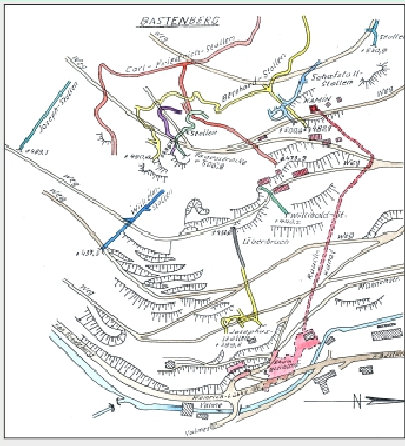
At the time of the so-called „Ramsbeck Union“ (1815 – 1850), mining experienced an extensive boom. Numerous mineable but costly tunnels were excavated in the ore veins of the Dörnberg and Bastenberg. The „Josephus adit“ (29 m above the level of the Valme) with its oval mouth was driven almost 100 m into the Bastenberg. An overbreak (inclined shaft) at the end of the gallery with an inclination of about 45 degrees came to light after 90 metres. The opening was known as „a dangerous hole“ for a long time before it was closed.
The raw ore, extracted by blasting and already sorted in the mine, had to be separated from the dewy rock after extraction: After the pieces of ore were crushed by hand-operated punches near the mouth of the adit, boys who were still of school age pounded the smaller pieces with hammers during the summer months. The girls, on the other hand, had to wash the so-called „Grubenklein“ and sort it with sieves. Before this ten-hour work (50% – 25% of the daily wage for adults), the children already had lessons at the „Bergschule“ from 4.30 a.m. to 7.30 a.m. at times.
The small-grained ore prepared in this way was now transported to the inclined shaft (ore chute) and dumped there. It was then transported through the Josephus adit to the nearby Poch-Wasch processing plant on the Valme. There the ore, which was closely intergrown with the surrounding rock, was mechanically crushed in the poching plant and then separated from the dewy rock by gravity. Finally, the ore was transported to the lead smelter.