

14 Two-flue Smoke Extraction Duct
As already mentioned at the information desk at the chimney of the mining hiking trail, from 1854 onwards the exhaust gases produced during the smelting of the ores, which were harmful to the environment, were drained off through a masonry channel to the chimney on the Bastenberg. The canal is almost always single-flue, only double-flue over a length of about 20 metres. Why?
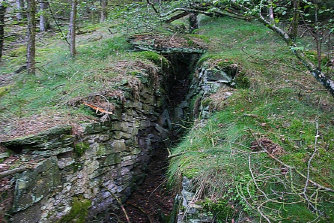
Ehemaliger, einzügiger Rauchgaskanal mit Abdeckplatte.
In the smelting process, the crushed ores were first roasted in coal-fired furnaces by blowers driven by steam boilers to such an extent that the metal and the sulphur bound to it separated. The exhaust gases that developed consisted mainly of carbon dioxide (CO2), sulphur dioxide (SO2), metal oxides and water vapour. Sulphuric acid formed from the sulphur dioxide in combination with the humidity in the air, which precipitated on the ground and caused severe damage to vegetation in the vicinity of the smelter.
In the double-flue section not far from the lead smelter, the aim was presumably firstly to ensure stability because of the heavily polluted path leading over it, and secondly to allow most of the humidity in the air to condense quickly with the sulphuric acid on the four high, cold walls. In this way, one wanted to avoid environmental damage in the further course of the canal and in the air („acid rain“) to a large extent. The water created by the condensation was collected in a gutter at the bottom of the canal. However, it is not known whether it was always possible to neutralise the „acid“ water sufficiently by chemicals after it returned to the lead smelter so that it could then be discharged unpolluted. The other substances in the waste gases – soot and volatilised metal – settled immediately in front of the chimney after the draught had been reduced. (see information desk at the chimney!)