
11 Chimney of the Former Lead and Metal Works with Flue Gas Duct
During roasting, 150 years ago ad in later times, the sulphur was driven out of the galena in the Ramsbeck lead and metal works. The proportion was about 13 %. Because of a Prussian ministry requirement, these gases, which were harmful to the entire environment, had to be led out of the inhabited valley of the Valme.
At that time, it was not yet possible to build tall chimneys. Therefore, in 1854, a square chimney stack was erected on the slope of the Bastenberg and the harmful flue gases were led from the lead smelter through a 385 m long brick channel up the mountain slope to a chamber system directly at the chimney, where they were first cleaned. (The remains of this flue gas duct can be seen on the slope below the path).
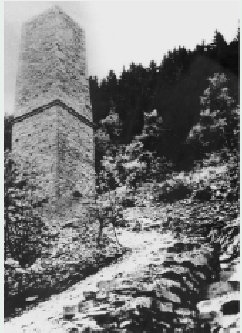
Due to the favourable topographical conditions, the initially hot gases were given a natural draught and cooled down on their way up to such an extent that lead smoke and flue dust settled in the horizontal passages of the chamber system with reduced draught. The flue gases could then be released into the air 150 metres above the Valmetal. The smoke chambers were cleaned from time to time and the precipitated substances (e.g. lead white for paint production) were recovered. The workers assigned to this task were given bacon, milk and schnapps during their hazardous work.
The flue gas chimney, which is now a listed building, became a Ramsbeck landmark after it was decommissioned in 1907. Since 1982, the „Kamin-Fahnen-Förderverein“ has been responsible for its upkeep. Throughout the year, the national flag flies from the upper rim. As Christian symbols, a cross shines here at Easter time and a star at Christmas time.