

5 Evangelical Church of St. Peter – Ramsbeck Mining Church of Lights
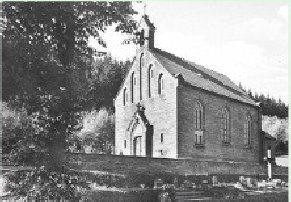
In the middle of the 19th century, the Ramsbeck mining industry began to expand on a large scale. To this end, workers were recruited who immigrated to the Ramsbeck area from the Harz Mountains, Thuringia and Saxony around 1854.
On 4 October 1854, the first trek of miners and their families arrived at the Andreasberg colony. They were all baptised Protestant Christians who were to be brought together to form a congregation.
The emergence of a Protestant congregation
The theological candidate and assistant preacher August Disselhoff does fundamental work. He began his ministry in Andreasberg on 6 March 1855. Many miners are distant from the church and reject the Christian faith. Poverty, cultural and social neglect determine their everyday lives.
A workers‘ flat in Andreasberg is made into a makeshift „local“, where Disselhoff celebrates a church service for the first time on 10 March. On 17 March, the first church service is held in Heinrichsdorf; miners, mainly from Saxony, had been given accommodation here. Disselhoff visits the people in their homes and gets to know the misery of their living conditions on the spot. He trusts that he
can find access to the people through the word of the Bible, through preaching and catechetical instruction, but also through personal conversation. The high reception he received in the church services exceeded his expectations. He thus laid the foundation for the first Protestant congregation in the Ramsbeck area.
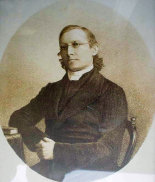
August Disselhoff is the poet of the song „Nun ade, du mein lieb Heimatland“, which he wrote in Arnsberg in 1848.
August Disselhoff as a young man
The building of a church
After years of provisional arrangements and protracted negotiations with the higher church authorities, the foundation stone for the Protestant church in Ramsbeck was finally laid „at St. John’s Day“ (24 June 1878). Wilhelm Moelle, a master builder from Minden, designed the building in neo-Gothic style as a hall church. The building blocks were broken „on site“. At the beginning, the church room was equipped for 168 seats; in addition, children’s seats were provided in the organ loft. The open bell tower above the portal is striking.
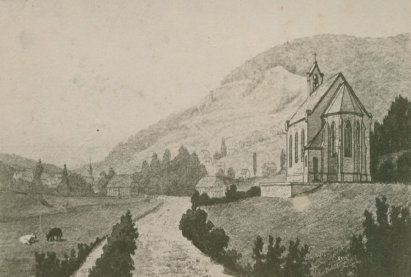
The church was consecrated by Superintendent Wiesmann and Superintendent Marpe from Soest on the 1st Sunday of Advent in 1879. This makes it one of the oldest Protestant churches in Hochsauerland.
The newly established villages of Neu-Andreasberg and Heinrichsdorf, whose houses were built for the foreign miners‘ families, initially formed the pastoral focus for the first pastors working here. Later, the centre of the parish shifted to Ramsbeck.
Since 1978, the church has been a listed building because it is, in its almost unchanged form to this day, „a late successor to the church buildings based on model designs of the Berlin Oberbaudeputation from the middle of the century … and is of importance for the church stock of the Hoch-Sauerland district.“
In 1995, the entire building was renovated and thoroughly refurbished. It was given the name „Petrus-Kirche“.
The church as a place of new religious experience
The number of parishioners has decreased considerably at present. However, the church building remains a symbol of
a Christian way of life.
He refers to the first beginnings in a difficult time of industrialisation in the Ramsbeck area, in which the miners‘ families who had moved to the area were looking for a new existence. The young Protestant congregation was able to offer them protection and strengthen social cohesion in their new home.
Even after the end of the war in 1945, many displaced people from Silesia, Pomerania and East Prussia found a new home here. Pomerania and East Prussia found accommodation here. They soon belonged to the Protestant congregation, where they were also able to make contact with people in their new surroundings. Today, this church once again invites people to take a break from everyday life in prayer, listening and quiet reflection, contemplation and contemplation. A „church of lights“, a place of spiritual experience that brings its actual purpose into view in a new way.
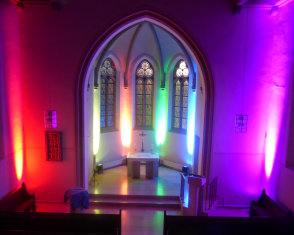
The project
„Mining Church of Lights Ramsbeck“ is supported by the „Förderverein Sauerländer Besucherbergwerk Bestwig-Ramsbeck e.V.“ and was funded by the European Union and the state of North Rhine-Westphalia as a LEADER project.