
38 The Ramsbeck Mill
A mill was first mentioned in Ramsbeck in a tax list of the Cologne Elector Maximilian Heinrich in 1685: The minstrel, a miller, „needs a room, lives in the mill in the village, but also has a house. This minstrel therefore used one of the mill wheels to drive a sawmill, while the other was used by the miller to grind the grain. According to oral tradition, the farmer Jobst Nölcke, called Hüttemann, received this hereditary mill from the Elector during his stay in Ramsbeck in exchange for a bee colony.
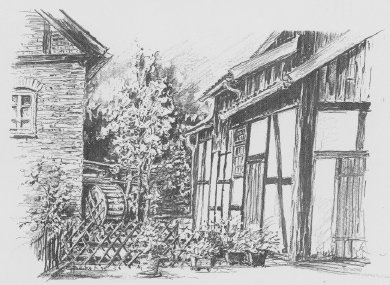
The present old water mill in Ramsbeck dates back to 1810 and had – unique in all of Westphalia-Lippe – three mill wheels: Obviously, the grain or saw mill was also used to produce oil from rape or flax. Around 1865, the mill equipment was renewed. At that time, the Gordes family had come into possession of the mill. At the beginning of the 20th century, one of the water wheels drove a turbine to generate electricity for the lower village of Ramsbeck, before the whole village was connected to the public electricity grid in 1922. After that, the miller Fritz Gordes extended the grinding mill with a contract threshing mill in the neighbouring building; the threshing machine was connected to the mill via transmission. Some miners were also regular customers.
The last grain was threshed or ground in 1956 by Gustav Nölke, known as „Stöves“. Because the old water mill in Ramsbeck with its three mill wheels and the still well-preserved grinding stand is a unique cultural asset in North Rhine-Westphalia worthy of special protection, it was listed in 1983. The mill association „Alte Kornmühle Ramsbeck e.V.“, which was founded some time ago, strives to restore the mill as well as possible and to „fill it with life“ again.