
35 Draining of the Willibald – Halde
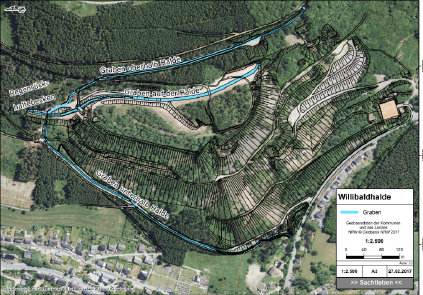
Drainage system Willibald – slag heap
The Willibald slagheap is part of the historic Ramsbeck lead-zinc mine, which, according to the latest information, dates back to the end of the 11th century. Mining had to be stopped in 1974 for economic reasons. The Ramsbeck deposit is one of the most important lead/zinc/silver ore deposits in Europe. A total of around 16 million tonnes of ore were mined here up to 1974. The deposit comes to the surface in numerous places and was mined in small-scale open-cast mining, then in drift mining and finally in deep mining to a depth of almost 500 metres.
Due to the low ore content of the mine production of about extracted from the mine had to be deposited on heaps after (processing). At the Willibald waste rock pile, waste rock stockpiled in accordance with the mining permits. After the mine recultivated and greened.
As a result, the slag heap is now largely covered with vegetation 4616-301) because of the rare plants and herbs that have settled areas for nature and landscape conservation.
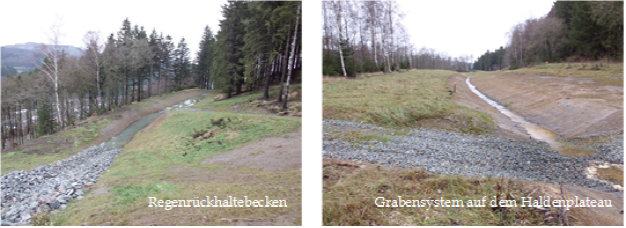
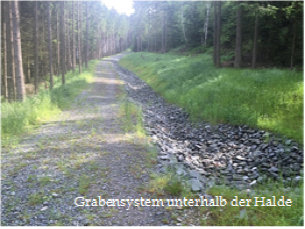
Due to the increase in heavy rainfall events as a result of climate change, additional trench systems for the drainage of surface water were constructed in 2014 to protect the tailings pile. The aim is to divert the precipitation water flowing into the heap from above around the heap and to quickly drain off the precipitation from the heap plateau. For this purpose, 3 efficient ditch systems were constructed 1. above, 2. on the slag heap and 3. below the slag heap as well as a deadwood and a rainwater retention basin.
The deadwood basin retains wood/debris and alluvial deposits, while the rainwater retention basin ensures that the water from above the slag heap and from the slag heap plateau is fed into the Eltmeckebach stream with a time delay in the event of heavy rainfall, thus relieving the stream system.
The ditch systems were integrated into the landscape in a natural way and built in accordance with the requirements of the FFH area.