
34 The Tailings Pond above the „Willibald“ Processing Plant
Above the Willibald processing plant, which was completed in November 1889, there was a thickener and a slurry pond for the outlets of the flotation plant. This plant, built in 1935, was able to process 650 tonnes of ore a day at that time, later 1,000 tonnes, and to extract about 65 and 100 tonnes of lead and zinc concentrates from it. About 90 per cent by weight of the throughput was fine-grained, largely metal-free so-called tailings which were produced in the form of a sludge slurry. This sludge was pumped to the thickener (diameter approx. 35 metres). Here, the solids settled; the clarified water without solids ran off at the overflow and was reused as process water in the treatment plant.
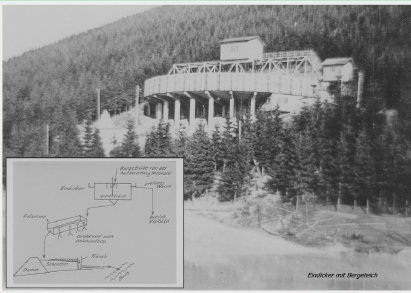
The solids deposited in the thickener were lifted to the central drain in the ground and discharged in the form of a thick sludge slurry. The sludge was discharged in the form of a thick sludge circle, which passed through a wooden channel to the nearby sludge pond, which was about 100 x 50 m in size. Holes with a diameter of about 50 mm were made in the floor of the wooden channel, through which the coarsest sand ran out. This coarse sand was used to build up the surrounding pond embankment with shovels. The slope of the dam on the valley side had a ratio of about 1:3.5 (on 3.5 m = 1.0 m slope = 29%). The finer solids of the Bergedick sludge settled in the middle of the pond. At the end of the pond there was a clear water overflow (monk) through which the residual water was led to a stream.
When the new Bilmecke sludge pond near Andreasberg was completed in 1955, the thickener and the tailings pond above the Willibald treatment plant were shut down. No process water was pumped back from the Bilmecke pond, but was discharged through the Bilmeckebach into the Valme (below Heringhausen).
Source: Retired mining director Dr. Bruno Heide – responsible for the processing plants of Sachtleben Bergbau GmbH, from 1970 until its closure in 1974 also for the Willibald processing plant in Ramsbeck.