
24 The ‚Bremsberg‘
In November 1889, the new „Willibald Ore Processing Plant“ was commissioned on the western slope of the Dörnberg. The arduous and extremely expensive transport of the lead and zinc concentrates to the smelting plant was initially carried out by horse-drawn carts. When the Stolberger Zink AG was able to connect the Ramsbeck works to the Ruhr valley railway in Bestwig in 1896/97 with its own mine railway (750 mm gauge), the transport costs were reduced considerably.
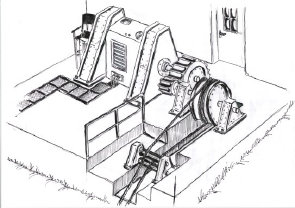
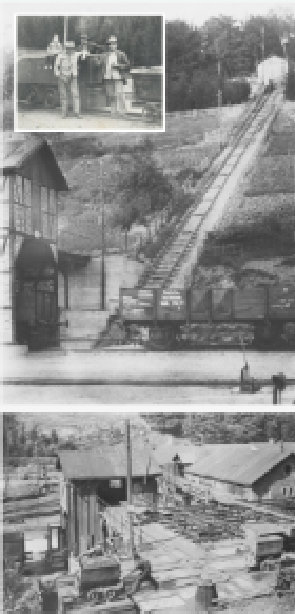
The concentrates were initially transported by a trolley track (gauge only 575 mm) from the processing plant about 1 km over a road bridge along the slope at the „Scheidt“ to the so-called „Bremsberg“: A platform running on rails was used to brake two full trolleys at a time from the upper engine house 100 m down to the level of the valley. The platform was connected by a rope over a pulley to a counterweight on four wheels, which ran underneath the platform and pulled the emptied lorries up again.
At the loading station, the ore concentrates were reloaded into the Reichsbahn wagons (1435 mm gauge) standing on trestles of the narrow-gauge railway and taken to Bestwig by mine train (popularly known as the „little train“). In 1952, two huge trucks, each capable of loading 30 tonnes per trip, took over the more cost-effective transport of the concentrates.
Engine house of the mountain station at Bremsberg.
Drawing by Thomas Kemper based on memories by Martin Hahn.