

19 Pochjungen on the Bastenberg
Child labour in earlier times
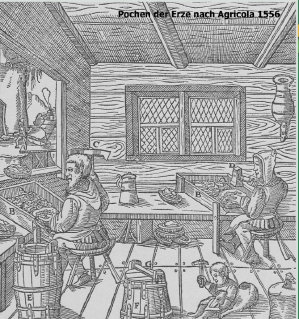
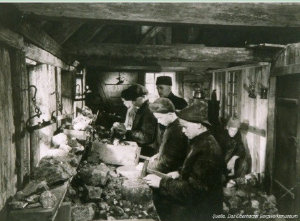
Since time immemorial, the ores have been manually pre-sorted in front of the gallery mouth after extraction from the mine, in order to separate the dead rock from the metal-bearing ore. In earlier times, this work was often done by 10 to 14 year old mining boys as well as women and girls. The boys were supervised by older miners; a foreman checked the diligence and honesty of the work, often
by beating them. In order to separate the lumps of ore from the worthless rock, they were pounded, i.e. smashed, with a hammer (mallet) on a thick metal plate lying on a separating bench. The crushed, metal-rich ores were collected in baskets for transport.
In the beginning, no consideration was given to the age of the boys who had to go „up the mountain“ in the summertime because their father earned too little or had died. Many of these children skipped school in the afternoon because of the work, despite the threat of a fine. In Ramsbeck, the conflict between vital child labour and daily compulsory schooling was solved from 1842 onwards by the temporary introduction of a „mountain school“: from Easter to October, special lessons for the Poch boys began early every working day at 4.30 a.m. and lasted until 7.30 a.m.!
„The lessons for the little miners were very hard work. In the morning at such early hour, still in the smell of lead and in the dust that was still swirling out of all the smocks from the previous day, holding school in a sleeping and awake state, who could say that this did not tire them“. (Commentary by school vicar Schupmann, who worked in Ramsbeck from 1846).
The physically very strenuous and dangerous work with hammers „on the mountain“ lasted from 8 a.m. to 6 p.m. during this time. The poor boys usually only received two to three slices of bread from their mothers to fortify them during the prescribed breaks; they also drank water from the nearby spring. There was only time for leisure activities on Sundays after church. The steward deducted the weekly school fees (1 silver groschen) from the wages, which the often 60 to 80 boys owed the teacher.
Later, when by law children were only allowed to work from the age of 12, the number of so-called miners‘ children shrank to 10 to 12 and even fewer. In 1879, these worked every day until noon, then went to school until 3pm, and then worked again from 3.30pm to 6pm. On Wednesday there was no school, then they worked all day.
Even today, in poor countries, children have to work to feed the family. For example, in the city of Potosi in Bolivia, located at an altitude of over 4,000 metres, even seven-year-olds help their mothers to knock copper, lead and zinc out of the stones. Although child labour is officially banned in Bolivia, more than a thousand children allegedly work in the mines of Potosi under catastrophic conditions because of their poverty. This is not hushed up even in front of tourists, on the contrary.