
10 Mining Archaeology in the Bastenberg
Facts, myths and legends about the Venetian gallery
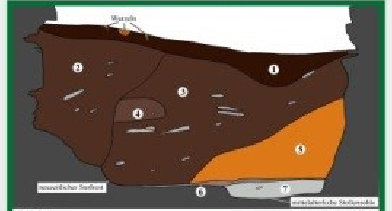
In August 2011, an archaeological survey was required in front of the present mouth of the Venetian gallery. In four profile sections and a single profile in the slope of the forest road, gallery features were recorded in each case (Fig. 2). The former gallery thus extended much further than it does today. Particularly revealing was the southern profile in section 1, a good 2 m before the mouth hole (Fig. 3). Measured from the top of the ground, the profile was 1.1 m deep. Beneath the humus layer (Fig. 3.1), layers of debris were revealed (Fig. 3.2-4), which had been created by the collapse of the adit in this area. Below this was a medium brown-grey, loamy layer containing shale fragments and occasional charcoal (Fig. 3.5). This was followed by an almost continuous layer resting on the bed to the east (Fig. 3.6), which was dark grey, consolidated and oxidised to a reddish-brown in places. Below this, a loamy clayey, light grey-brown deposit with charcoal had formed in a depression in the west (Fig. 3,7). This depression is the floor of an older gallery, on which pottery of the 13th century and charcoal were found. Part of the associated wall (butt) has also been preserved. On the opposite east side, a younger butt was found, probably from the 18th century. All in all, the investigation showed that the medieval gallery originally ended in the area between today’s forest road and the dump area. The dating of the older gallery finds is supported by pottery from the 11th – 13th centuries, as well as a blacksmith’s site of the same age on the dump site below the Venetian gallery.
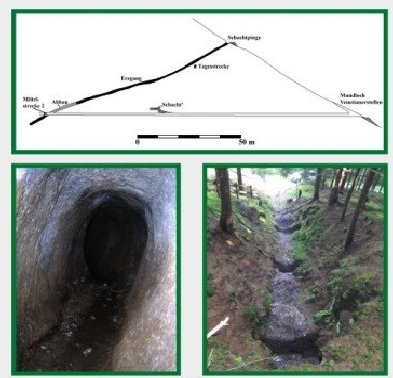
The dating of the features from profile section 2 is confirmed underground. The adit, which was already driven in the Middle Ages from north to south into the Bastenberg ore vein, has a total length of 154 m up to the point of collapse. The first 70 m of the older adit were almost completely covered over in the 18th century. In its further course, the gallery has mostly a round-oval cross-section of up to 1.30 m in height and approx. 0.60 m in width (Fig. 4). In places it was excavated by fire-setting, otherwise with pointed chisels and wedges. In its rear section, the Venetian gallery is intersected by a 19th century roadway. There, a finding with traces of hammer-iron work has been preserved, which can be dated to the 16th – 17th century. Furthermore, the Bastenberggang is exposed here. Mines are accessible which can be attributed to the high medieval mining phase and in which work was partly done with fire setting. Radiocarbon analyses of charcoal samples have dated these areas to the 10th-12th centuries. The chronological classification of a ceramic find also corresponds to this.
Venetian, Venetian, Walen, Welsche …
In the 1930s, Heinrich Quiring associated the Venetian gallery with the Venetian tribe, which at that time dated to the Bronze Age (in Central Europe from about 2200 to 800 BC). In addition, Venetian legends have been handed down for the Bastenberg, as in some other European mining regions. In these, the Venetians appear as mining experts, knowledgeable ore prospectors who were attributed magical abilities and who worked in secret. But who were the Venetians, who were also called Venetians, Walen, Welsche (= foreigners) or Italians?
Historical records show that from the end of the 13th century Italians worked in silver mining and production in a managerial capacity, for example in Freiberg and Kutna Hora (Kuttenberg). Some may also have been looking for new sources of metals, especially copper, due to the trade policy of the Republic of Venice.
The latter decided in the 13th century that its merchants could only sell copper at certain times of the year and that no citizen outside its territory could process it. At the same time, copper imports were encouraged. In addition, the state paid strict attention to the secrecy of smelting techniques.
The basic statement that the Venetians were experts in mining and smelting as well as coinage and finance is very likely true. Since not all methods and tools were known or subject to secrecy, they were probably explained with magic and the stories embellished with other legendary ideas. Nevertheless, many of the Venetian legends are important evidence of an otherwise barely documented medieval mining activity. The tradition of secret searching continued into the 18th/19th century, among other things with so-called „whale books“, guidebooks to treasures and deposits.
Martin Straßburger M.A.
Förderverein Sauerländer Besucherbergwerk Bestwig-Ramsbeck e.V.
A project in cooperation with LWL Archaeology Westphalia